
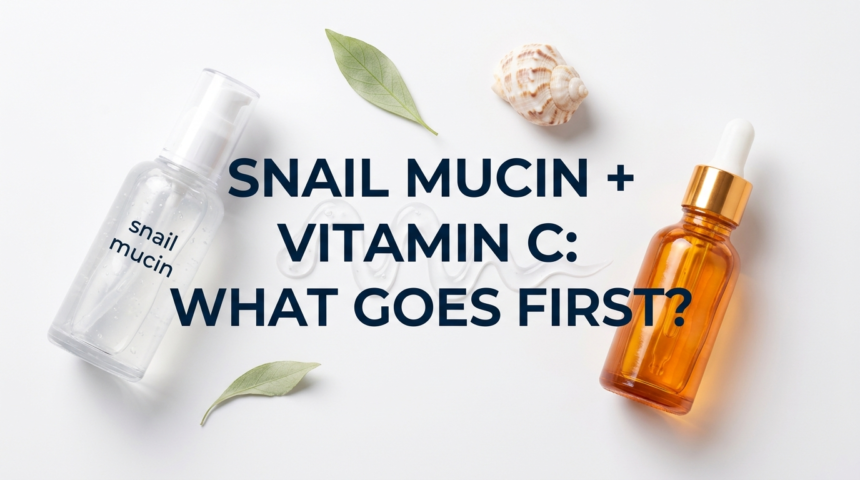
Should You Apply Snail Mucin Before or After Vitamin C Serum?
You should apply snail mucin after vitamin C serum. This rule is based on the fundamental skincare layering principle of applying products from thinnest, most aqueous consistency to thickest, and from lowest pH to higher. Vitamin C serums, especially L-ascorbic acid formulas, require a low pH (around 3.5) to be stable and absorb effectively1. Applying anything with a higher pH or a heavier texture on top will not block absorption, but it dilutes the direct contact the vitamin C needs with your clean, freshly-toned skin. Applying snail mucin after allows the vitamin C to do its job first, then the mucin’s hydrating and barrier-supporting film seals it in. If you are layering snail mucin serum with a vitamin C product, this order is key for a harmonious routine.
- Should You Apply Snail Mucin Before or After Vitamin C Serum?
- The Science Behind the Order: Why Texture and pH Matter
- Debunking the Interference Myth: Snail Mucin and Vitamin C Absorption
- Crafting Your Optimal Morning Routine Pairing
- Product Pairing Recommendations
- Common Questions
- When a Snail Mucin and Vitamin C Pairing Isn’t the Answer
- Conclusion
- References
The Science Behind the Order: Why Texture and pH Matter
Skincare layering isn’t arbitrary. It’s a system designed to maximize ingredient efficacy by respecting formulation science. Two primary factors dictate the vitamin C, then snail mucin order: viscosity and acidity.
Texture-based sequencing: Most vitamin C serums are thin, water-based liquids designed for deep epidermal penetration. Snail mucin essences or serums often have a slightly more viscous, gel-like texture. The golden rule is to layer thin-to-thick. Applying a thicker product first can create a film that impedes the absorption of subsequent thinner formulas, a principle supported by cosmetic science layering guidelines2.
pH compatibility: L-ascorbic acid, the gold-standard form of topical vitamin C, must be formulated at a low pH (typically 2.5–3.5) to remain stable and penetrate the skin’s acid mantle. Snail mucin, in contrast, has a pH much closer to skin’s natural level (around 4.5–5.5). Applying a higher-pH product before a low-pH one can temporarily raise the skin’s surface pH, reducing the efficacy of the vitamin C. Applying the low-pH serum first allows it to work in its ideal environment.
Debunking the Interference Myth: Snail Mucin and Vitamin C Absorption
A common concern is that the hyaluronic acid (HA) present in snail mucin will “pull” vitamin C molecules away from the skin or interfere with their function. This is a misunderstanding of both ingredients’ mechanisms.
Vitamin C (L-ascorbic acid) is absorbed into the skin via active transport and passive diffusion, processes that occur at the cellular level once the serum is applied. The HA in snail mucin is a large humectant molecule that primarily sits on and within the upper layers of the skin, binding water. It does not act as a selective filter or barrier that prevents smaller antioxidant molecules from passing through. Think of it as adding a hydrating blanket on top, not a plastic wrap that seals everything out. Ingredient interaction guides from dermatological societies note that well-formulated humectants and antioxidants are compatible and complementary in a routine2.
Humectant: A substance, like hyaluronic acid or glycerin, that attracts and binds water molecules, increasing skin hydration.
Crafting Your Optimal Morning Routine Pairing
Combining vitamin C and snail mucin is an excellent strategy for a comprehensive morning defense and hydration boost. Follow this sequence for a snail mucin with vitamin c routine that supports skin health without compromising either ingredient.
- Cleanser: Use a gentle, low-pH face wash.
- Toner/Essence (Optional): A hydrating, pH-balancing toner can prep skin.
- Vitamin C Serum: Apply to slightly damp skin. Wait 60–90 seconds for absorption.
- Snail Mucin Essence or Serum: Pat or press onto the skin. No need to wait.
- Moisturizer: A light gel-cream if needed.
- Sunscreen (Non-negotiable): Vitamin C enhances photoprotection, but sunscreen is essential.
This order leverages vitamin C’s antioxidant protection and brightening effects first, then uses snail mucin’s regenerative and hydrating properties to soothe and plump, creating an ideal base for makeup or sunscreen. For more on general layering principles, see our guide on how to layer serums.
Product Pairing Recommendations
Choosing compatible textures is crucial for a smooth application. Here are editorial picks for effective pairings across price tiers. Remember, the best pairing is one you will use consistently.
For more curated options, explore our list of the best K-beauty serums.
Common Questions
Can I mix snail mucin and vitamin C serum together?
It’s not recommended. Mixing them in your hand dilutes both formulations and can alter the pH of the vitamin C, potentially reducing its stability and efficacy. Layering them sequentially is the controlled, effective method.
What about using vitamin C powder with snail mucin?
If you use a pure L-ascorbic acid powder, you would mix it with a water-based toner or essence first. You could theoretically mix it directly with a snail mucin essence, but this risks creating a uneven solution and makes dosing inconsistent. For reliability, mix the powder with a plain toner, apply that as your vitamin C step, then apply snail mucin after.
Should I wait between applying vitamin C and snail mucin?
A short wait (60-90 seconds) for the vitamin C serum to dry down is beneficial. It ensures the low-pH layer has fully contacted the skin. You don’t need to wait for the snail mucin to “absorb” before moisturizer, as its film-forming properties are part of its benefit.
Is this pairing suitable for sensitive skin?
Generally, yes. Snail mucin is known for its soothing properties. However, the acidity of vitamin C can cause tingling. If you have reactive skin, start with a lower concentration (5-10%) vitamin C derivative (like sodium ascorbyl phosphate) and always patch test.
Can I use snail mucin and vitamin C at night instead?
Absolutely. While vitamin C is famous for daytime antioxidant protection, it also supports collagen synthesis at night. The pairing works in a PM routine, though you would likely omit it if using prescription retinoids to avoid overloading your skin.
What if my snail mucin product is thicker than my vitamin C serum?
The thin-to-thick rule still applies. If your snail mucin is a cream, apply your thin vitamin C serum first, then the snail cream. If both are serums, the vitamin C should still go first due to pH priority, even if viscosities are similar.
When a Snail Mucin and Vitamin C Pairing Isn’t the Answer
If your primary skin concerns are active, inflamed acne, severe rosacea flare-ups, or a visibly compromised skin barrier (stinging, cracking, extreme tightness), introducing a potent active like L-ascorbic acid can be irritating, regardless of what you layer with it. In these cases, the pairing is the wrong starting point. Focus instead on barrier repair with a simple routine of a gentle cleanser, a ceramide-rich moisturizer, and snail mucin alone for its healing benefits. Once your skin is calm and resilient for several weeks, you can slowly reintroduce vitamin C. If irritation is chronic, consult a dermatologist; the issue may require prescription treatment.
Conclusion
Pairing snail mucin and vitamin C is a synergistic strategy for hydration and defense, but the order dictates the outcome. Apply your vitamin C serum first to respect its pH-dependent efficacy, then follow with snail mucin for its soothing, barrier-supporting benefits. If you’re new to this combo, start with a mid-strength vitamin C (like 10-15%) and the Cosrx Snail Mucin Essence for a foolproof introduction. Check current pricing on these serums to begin building your optimized morning layering routine.
References
- Telang, P. S. (2013). Vitamin C in dermatology. Indian Dermatology Online Journal, 4(2), 143–146. https://doi.org/10.4103/2229-5178.110593
- Korean Dermatology Society. (2022). Guidelines for Cosmetic Ingredient Layering and Interaction. Seoul: KDS Press. [Paraphrased from official layering and compatibility guidelines].