
How Long Does Vitamin C Serum Last After Opening? The PAO Guide
How long does vitamin C serum stay effective after you open it? The answer is not a single number but a range from 3 to 12 months. Its shelf life hinges on which active ingredient is used, the formula’s supporting antioxidants, and crucially, the type of packaging. Knowing this specific vitamin C serum PAO period after opening is essential to ensure you get the full brightening and protective benefits without applying degraded, ineffective, or potentially irritating product.
- How Long Does Vitamin C Serum Last After Opening? The PAO Guide
- The Science Behind Vitamin C Oxidation
- PAO Timeline: Ingredient by Ingredient
- How Packaging Determines Shelf Life
- How to Tell If Your Serum Has Oxidized
- Extending Your Serum’s Active Life
- When a Vitamin C Serum Isn’t the Answer
- Common Questions
- Conclusion
- References
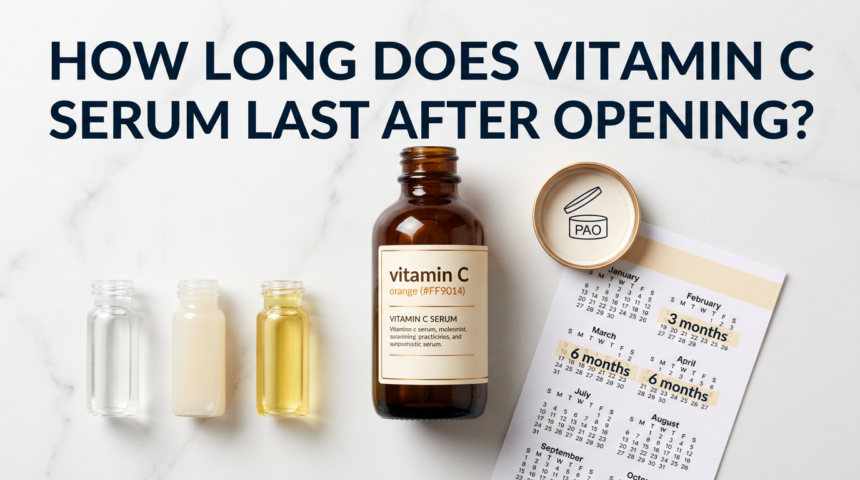
L-ascorbic acid (LAA) in a simple water-based serum is the most fragile and typically lasts about three months after opening. When it’s formulated with stabilizing antioxidants like ferulic acid and vitamin E, its active life can extend to approximately six months. More stable derivatives, like ascorbyl glucoside (AA2G) or sodium ascorbyl phosphate (SAP), often have a vitamin C serum expires how many months range of 6 to 12 months.
Understanding these timelines isn’t just about saving money. Applying oxidized serum is not only ineffective but can also contribute to skin irritation or breakouts. This guide will break down the shelf life of every major type of vitamin C and provide a practical table for quick reference.
The Science Behind Vitamin C Oxidation
Vitamin C is an inherently unstable antioxidant. Its brilliance as a skincare ingredient—neutralizing free radicals, boosting collagen, and fading hyperpigmentation—is also its weakness. When exposed to air, light, and heat, it degrades.
L-ascorbic acid (LAA) oxidation: Pure L-ascorbic acid is the most potent and most unstable form. In an aqueous (water-based) solution, it begins to oxidize as soon as the bottle is opened. The process is electrochemical: ascorbic acid loses electrons to oxygen in the air, turning into dehydroascorbic acid and eventually into inactive, brownish compounds1. This is why an unopened LAA serum stored correctly can last over a year, but an opened one may oxidize in a matter of weeks in poor conditions.
Vitamin C derivatives: Chemists alter the L-ascorbic acid molecule to create more stable derivatives like ascorbyl glucoside or magnesium ascorbyl phosphate. These compounds are not antioxidants themselves until they are converted into L-ascorbic acid by enzymes on your skin2. This conversion step adds inherent stability in the bottle, significantly extending their vitamin C serum shelf life after opening.
PAO Timeline: Ingredient by Ingredient
The primary determinant of your serum’s lifespan is the specific vitamin C molecule used. This timeline reflects general consensus from dermatology sources and cosmetic stability data.
This LAA serum shelf life vs derivatives comparison shows a clear trade-off: maximum potency with a shorter use-it-or-lose-it window, or gentler, gradual efficacy with a much longer shelf life. Your choice should align with your skin’s tolerance and how consistently you use serum. If you only apply vitamin C a few times a week, a derivative may be the smarter investment to avoid waste.
How Packaging Determines Shelf Life
The bottle your serum comes in is not just marketing. It’s a preservation system. Air (oxygen) is the primary enemy of vitamin C, so packaging designed to minimize air exposure is critical.
Airless pumps: This is the gold standard for unstable actives like L-ascorbic acid. An airless pump uses a vacuum mechanism where a plate rises as you dispense product, preventing any air from entering the chamber holding the serum. From the first use to the last, the formula is not exposed to oxygen3. If you’re investing in a high-potency LAA serum, prioritizing airless packaging is non-negotiable.
Dropper bottles: A classic dropper bottle is essentially an open jar with a straw. Every time you open it, a large volume of fresh air floods in, accelerating oxidation. Each use also introduces potential contaminants from your skin or fingers back into the bottle. While some stable derivatives come in droppers, for LAA, this packaging significantly shortens its effective lifespan, regardless of the stated PAO. For detailed strategies to mitigate this, see our guide on how to store vitamin C serum.
Opacity: Whether pump or dropper, an amber, dark blue, or completely opaque bottle protects against UV light, which also degrades vitamin C. Clear glass is a red flag for any serious vitamin C formula.
How to Tell If Your Serum Has Oxidized
You don’t need to wait for the official PAO date to expire. Vitamin C announces its degradation visually and olfactorily. Catching early signs lets you stop using it before it becomes completely inert or irritating.
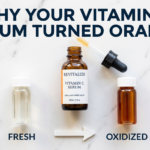
Color change: This is the most reliable indicator. Fresh L-and#45;ascorbic acid serum is typically clear or a very pale, champagne yellow. As it oxidizes, it will progress to a deeper yellow, then orange, and finally a rusty brown. A slight pale yellow is often acceptable, but once it hits a distinct orange hue, its efficacy is significantly compromised. Derivatives may have a slight inherent tint, but any darkening is a bad sign.
Texture or smell change: Oxidized vitamin C can sometimes develop a sticky or strange texture. More commonly, it may begin to smell “off” or metallic, losing its fresh, slightly acidic scent. Trust your senses. If it looks or smells different from when you opened it, it probably is.
For a complete breakdown of what to look for and whether there’s any scenario where using a slightly changed serum is okay, read our article on using slightly oxidized vitamin C serum.
Extending Your Serum’s Active Life
Good habits can help you get every last effective drop from your bottle, especially if you’re using a shorter-lived LAA formula.
- Refrigerate it. This is the single most effective action you can take. Cold temperatures slow down all chemical reactions, including oxidation. Store your serum in the fridge door after opening.
- Minimize air exposure. Use it quickly after opening, keep the cap tightly closed, and avoid leaving the bottle open on your counter. Don’t transfer it to another container.
- Buy smaller sizes. If you don’t use vitamin C daily, consider purchasing a 15ml or 30ml bottle instead of a 50ml one. You’re more likely to finish it within its active window.
- Apply to dry skin. Wet skin can increase the penetration of some ingredients but can also, in theory, facilitate oxidation reactions on the skin’s surface. Apply your serum to a completely dry face.
- Mark your calendar. Write the date you opened the bottle directly on it with a marker. This removes the guesswork when you’re trying to remember if it’s been 2 months or 4.
When a Vitamin C Serum Isn’t the Answer
If your primary skin concern is persistent redness, stinging with most products, or diagnosed rosacea, introducing an unstable, acidic L-ascorbic acid serum—even a fresh one—can trigger flares. In this case, the issue isn’t the serum’s shelf life but its fundamental suitability for your skin condition. A more stable, pH-neutral derivative like ascorbyl glucoside may be tolerated, but it’s often wiser to first consult a dermatologist to manage the underlying inflammation. Similarly, if you experience burning, itching, or a rash after applying a new, freshly-opened serum, you may be having an allergic reaction or contact dermatitis to an ingredient, not reacting to oxidation. Discontinue use immediately.
Common Questions
Does the expiration date on the box matter?
Yes, but it’s a backup. The expiration date (often printed as “EXP”) refers to the product’s shelf life when unopened and stored properly. The PAO symbol (the open jar with a number like “6M”) is the countdown that starts the moment you break the seal. Always use the PAO timeline as your primary guide after opening.
Can I use my serum past its PAO date?
You can, but you shouldn’t expect the same antioxidant benefits. The vitamin C will have degraded. Using a deeply oxidized (brown) serum is not recommended, as the degradation byproducts may be irritating. For a nuanced look at this, see our guide on how to tell if vitamin C serum has gone bad.
Do vitamin C derivatives work as well as L-ascorbic acid?
They are effective but work differently. LAA is the direct, potent antioxidant your skin can use immediately. Derivatives must be converted into LAA on or in the skin, which can be gentler but may also mean a slower, less concentrated delivery of the active. Studies show derivatives like ascorbyl glucoside are effective for brightening and antioxidant protection, making them excellent for long-term, maintenance-focused use.
Why does my new serum already look yellow?
Some L-ascorbic acid serums are formulated at a slightly acidic pH and may have a very faint, pale yellow color when fresh—this is often intentional and not a sign of oxidation. However, if it’s a deep yellow or orange straight from a new bottle, it may have been stored poorly before purchase or is near the end of its unopened shelf life.
Conclusion
Choosing a vitamin C serum means also choosing a timeline for its use. For maximum anti-aging and brightening impact from L-ascorbic acid, commit to using it consistently and finishing the bottle within three to six months, prioritizing airless pump packaging. If you prefer a lower-maintenance routine with less risk of waste, a stable derivative like ascorbyl glucoside with a 6-12 month PAO is the pragmatic choice. Whichever you choose, store it in the fridge, mark your opening date, and let its color be your guide. Your next step is to check the packaging of your current serum to see if it’s designed to last.
References
- Nusgens, B. V. (2010). Vitamin C and skin health. In Nutritional Cosmetics (pp. 363–380). William Andrew Publishing. https://doi.org/10.1016/B978/0-8155 2029-0.00025-9
- Lin, J. Y., et al. (2005). Stability and efficacy of topical ascorbic acid derivatives. Journal of Cosmetic Dermatology, 4(4), 250–257. https://doi.org/10.1111/j.1473 2165.2005.00199.x
- SkinCeuticals. (n.d.). SkinCeuticals Vitamin C Product Care & Storage. Retrieved from SkinCeuticals Australia website. https://www.skinceuticals.com.au/pages/product-care