
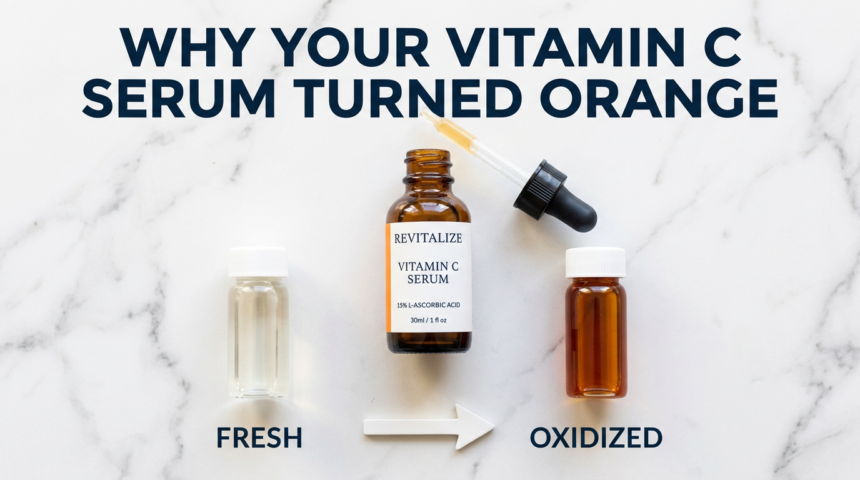
Your vitamin C serum turned orange because the active ingredient, ascorbic acid, has begun to oxidize. Oxidation is a chemical reaction where the molecule loses electrons, causing it to degrade and change color. Whether you can still use an orange vitamin C serum depends entirely on the shade, ranging from a functional pale amber to a pro-oxidant risk at dark brown.
The Chemistry Behind the Color Change
Pure L-Break-Ascorbic acid, the form most commonly used in serums, is a highly unstable molecule. It’s eager to donate its electrons to neutralize free radicals, which is why it’s so effective in skin care1. However, this very reactivity makes it vulnerable to environmental factors like air, light, and heat. When ascorbic acid oxidizes, it doesn’t immediately turn dark. It goes through a predictable, multi-stage degradation pathway that your eyes can track.
Oxidation pathway: The degradation sequence is ascorbic acid → dehydroascorbic acid → 2,3-diketogulonic acid. Initially clear ascorbic acid first converts to dehydroascorbic acid, which is still biologically active but less stable. This intermediate can appear as a very light yellow. The final degradation product, 2,3-diketogulonic acid, is the molecule responsible for the distinct orange and brown hues and has no antioxidant benefit2. The more diketogulonic acid present, the darker the serum.
The Color Spectrum: From Usable to Unsafe
Not all orange is created equal. The specific shade is your best visual clue to the serum’s state. Here’s how to interpret the color spectrum of your vitamin c serum turns dark.
This leads to the key question: is orange vitamin c serum still good? If it’s a light, honey-like amber, you likely have a short window of reduced efficacy. If it’s a deep orange or brown, the answer is a firm no. For more detailed guidance on borderline cases, see our guide on using slightly oxidized vitamin C serum.
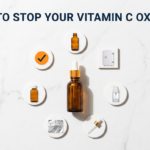
What Causes Vitamin C Oxidation (And How to Stop It)
Oxidation is accelerated by three main environmental aggressors. Understanding them is the first step to prevention.
- Oxygen (Air Exposure): Every time you open the bottle, ambient air rushes in. Ascorbic acid reacts with dissolved oxygen in the formula. This is why packaging matters profoundly.
- Light (Especially UV): Photons from light provide energy that drives the oxidation reaction. Clear glass bottles are the worst offenders, allowing full spectrum light to degrade the contents.
- Heat: Higher temperatures increase molecular movement, making reactive collisions between ascorbic acid and oxygen more likely. Storing serum in a warm bathroom guarantees a shorter shelf life.
Your defense strategy is straightforward: minimize exposure. Choose serums in dark, airtight, opaque bottles with pumps or droppers that limit air intake. After use, store the bottle in a cool, dark cupboard or even the refrigerator (if the brand recommends it). Use it consistently within 3-6 months of opening.
Smart Serum Selection to Combat Oxidation
Your first line of defense is buying a well-formulated and packaged product. While we aren’t pushing specific products in this educational guide, understanding what to look for empowers you. The best serums for stability combine smart packaging with stabilizing ingredients.
Editorial judgment: A ferulic acid and vitamin E combination is the gold standard for stabilization, but it often comes in a lightweight, aqueous formula that still requires careful storage. Don’t be seduced by pretty clear glass bottles, even if they contain this proven combo, the packaging is working against the formula.
Some brands use anhydrous (water-free) formulas or suspensions to enhance stability, but these can feel gritty or oily. It’s a trade-off: superior shelf life sometimes comes with a less elegant texture. When choosing, prioritize dark glass or opaque plastic with an air-restrictive pump over a simple dropper top.
Beyond the Bottle: Application Habits That Matter
How you handle your serum daily significantly impacts its lifespan. Good habits can extend the functional life of even a moderately stable formula.
Always apply serum to clean, dry hands or directly to your face to avoid introducing bacteria or moisture from your palms into the bottle. Replace the cap tightly and immediately after use. Do not decant serum into smaller containers; this vastly increases surface area exposure to air. If you notice the faintest yellow tinge, move the bottle to the refrigerator and commit to using it within the next few weeks. For a full checklist of freshness indicators beyond color, our article on how to tell if vitamin C serum has gone bad covers texture and smell changes.
Common Questions
Can I mix my orange serum with something to revive it?
No. Once ascorbic acid has degraded to diketogulonic acid, the reaction is irreversible. Adding other antioxidants or adjusting pH will not reconstitute the broken molecule. Using a deeply oxidized serum risks pro-oxidant damage.
Does a darker serum cause skin staining?
Potentially, yes. The degradation products, particularly in a dark orange or brown serum, can temporarily stain the stratum corneum (the top layer of skin) a yellowish color. This is harmless and will wash off, but it’s a clear sign the serum is far past its prime.
Are all vitamin C derivatives stable and clear?
Most derivatives, like sodium ascorbyl phosphate or magnesium ascorbyl phosphate, are formulated to be more stable and resist vitamin c oxidation orange color changes. They often remain clear for longer but must still convert to ascorbic acid in the skin, which may be less efficient. Stability often comes with a trade-off in direct potency.
If my serum is only light yellow, is it still effective?
Light yellow indicates the beginning of oxidation. The concentration of active, potent ascorbic acid is declining, but some antioxidant activity remains. It’s less effective than a fresh bottle but likely still provides some benefit if used promptly.
When an Orange Serum Isn’t the Answer
If you’ve followed all storage advice and your serum still oxidizes rapidly (within a month), the problem may not be you. The formulation itself could be fundamentally unstable with poor packaging or an incompatible pH. In this case, continuing to buy the same product is futile. Instead, research and switch to a serum known for stability with opaque, airless packaging. Furthermore, if you have highly reactive or sensitized skin and apply a dark orange serum that causes stinging, redness, or breakouts, stop immediately. Your barrier may be compromised, and the pro-oxidant load is causing inflammation. Discontinue use, focus on barrier repair with ceramides and a simple moisturizer, and consult a dermatologist if irritation persists.
Conclusion
Choosing and maintaining an effective vitamin C serum requires understanding its inherent instability. The orange color is a clear chemical signal. Trust the gradient: pale amber means use it fast, dark brown means toss it. To maximize your investment, always prioritize opaque, airtight packaging and cool, dark storage from day one. For your next purchase, let this knowledge guide you past marketing and toward formulas built to last, and always check our guide on common vitamin C serum myths to avoid other pitfalls.
References
- Sauermann, K., et al. (2004). Topically applied vitamin C increases the density of dermal papillae in aged human skin. BMC Dermatology, 4, 13. https://doi.org/10.1186/1471-,5945-4-13
- Linster, C.L., & Van Schaftingen, E. (2007). Vitamin C: Biosynthesis, recycling and degradation in mammals. FEBS Journal, 274(1), 1–22. https://doi.org/10.1111/j.1742-4658.2006.05607.x