
Can You Use Slightly Oxidized Vitamin C Serum? The Direct Answer
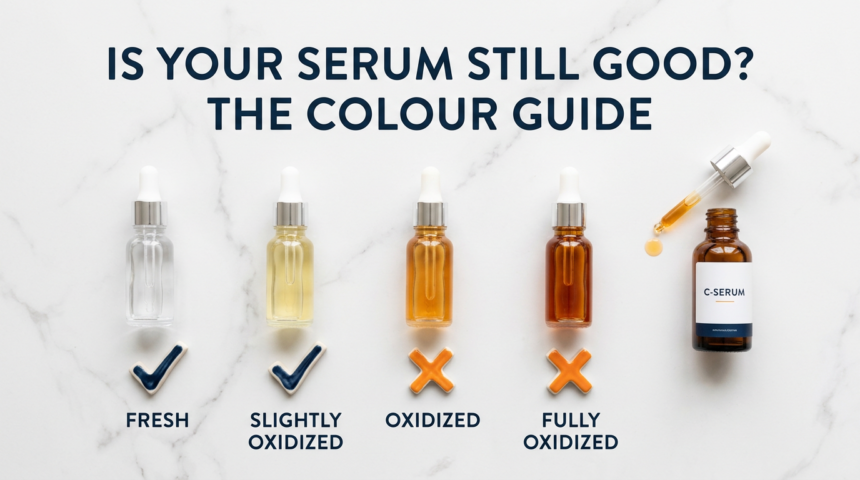
Is it safe to use vitamin C serum that has turned slightly yellow or orange? The answer is not a simple yes or no. It depends entirely on the degree of color change, which is a visual cue to its chemical state. A pale yellow or light straw color often indicates a stable, fresh product you can use with full confidence. An amber or dark orange hue signals advanced degradation, and the serum should be discarded. Between these extremes lies a nuanced range where your slightly oxidized serum may still deliver some antioxidant benefit, but with significantly reduced potency.
- Can You Use Slightly Oxidized Vitamin C Serum? The Direct Answer
- The Chemistry of Vitamin C Oxidation
- The Vitamin C Serum Color Guide: From Fresh to Finished
- Is a Slightly Yellow Serum Still Effective?
- What to Do with an Oxidized Serum (By Color)
- Preventing Oxidation: How to Keep Your Serum Fresh
- Common Questions
- When a Color Guide Isn’t the Answer
- Conclusion
- References
The color change you see is the active ingredient, L-ascorbic acid, reacting with oxygen and light, a process called oxidation. This transforms it first into dehydroascorbic acid (DHA) and eventually into 2,3-diketogulonic acid, which provides no skincare benefit. Your serum’s color acts as a real-time, built-in expiration date. Understanding what each shade means empowers you to use your products effectively and safely.
The Chemistry of Vitamin C Oxidation
To understand the color guide, you need to know the basic chemical journey. Pure L-ascorbic acid, the gold-standard form of topical vitamin C, is a water-soluble antioxidant that is inherently unstable when exposed to air (oxygen), light, and heat. Its instability is the price of its high skin bioavailability.
Oxidation: The process where L-ascorbic acid loses electrons, transforming it into dehydroascorbic acid (DHA). DHA is a transient, still-active intermediate. Further oxidation irreversibly degrades DHA into 2,3-diketogulonic acid and other compounds, which are brownish and inactive.
When you first open a fresh, well-formulated serum, it should be clear or have a very faint, watery yellow tint. This pale color can come from other ingredients like ferulic acid, which is often added to stabilize the vitamin C. The critical change to watch is a progressive darkening of this yellow hue. Research, including studies cited in journals like Free Radical Biology, outlines this degradation pathway, confirming that color darkening correlates directly with the loss of active, protective L-ascorbic acid and the accumulation of its breakdown products.
The Vitamin C Serum Color Guide: From Fresh to Finished
Use this visual guide to assess your serum’s state. Always evaluate the color in natural light against a white background for the most accurate read.
Is a Slightly Yellow Serum Still Effective?
This is the core of the query vitamin c serum turning yellow safe. When your serum is a uniform light yellow, it has entered the early stages of oxidation. At this point, the primary active (L-ascorbic acid) is diminishing, but its first oxidative product, dehydroascorbic acid (DHA), is present. DHA is still biologically active and can be taken up by skin cells, where it may be converted back into active ascorbic acid. However, this conversion is inefficient and not guaranteed.
The consensus among cosmetic chemists and dermatologists is that a light yellow serum retains a portion of its antioxidant activity, but it is significantly less potent than a fresh one. You might still get some hydrating or very mild brightening effects, but its ability to neutralize free radicals from UV exposure—a primary reason for using vitamin C in the morning—is compromised. Think of it as a diluted version of its former self. It’s not harmful, but it’s suboptimal.
What to Do with an Oxidized Serum (By Color)
For Light Yellow Serums: Move it to the front of your skincare queue. Use it daily, ideally twice a day, to finish it within a couple of weeks. Do not buy a backup bottle until this one is empty. You can continue using it as part of your routine, but manage your expectations regarding results.
For Dark Yellow/Amber Serums: This is where you need to make a call. While not recommended for the face, you could repurpose it on less sensitive areas of the body, like the backs of your hands or elbows, where the skin is thicker and the risk of irritation is lower. This is a strictly “use it up” tactic, not a recommended skincare practice. Do not apply it to your neck or décolletage.
For Orange/Brown Serums: There is no safe repurposing. The degradation products offer no benefit and can be pro-inflammatory. The best practice is to discard the serum. To prevent future waste, invest time in learning proper vitamin C serum storage techniques, which can dramatically extend its shelf life.
Preventing Oxidation: How to Keep Your Serum Fresh
Prevention is always better than assessment. A stable serum starts with choosing a well-formulated product, but your handling dictates its lifespan.
- Store It in the Fridge: This is the single most effective step. Consistent, cool temperatures slow down molecular activity and oxidation. Keep it in the main compartment, not the door.
- Minimize Air Exposure: Always screw the lid on tightly immediately after use. Avoid leaving the bottle open. Consider purchasing serums in airless pump packaging, which limits oxygen contact.
- Keep It in the Dark: Store the bottle in its original box or inside a drawer. Amber or opaque bottles are designed to block light; don’t defeat their purpose by leaving them on a sunny windowsill.
- Practice Clean Application: Wash your hands before use. Avoid dipping fingers into the bottle. Use the dropper or pump directly onto your skin or fingertips.
- Buy Smaller Sizes: If you use vitamin C infrequently, a 15ml or 30ml bottle may be more practical than a 60ml one, ensuring you use it all while it’s fresh.
For a deeper dive into the science behind keeping your antioxidant active, read our guide on vitamin C serum stability.
Common Questions
Does a yellow vitamin C serum cause skin damage?
A slightly yellow serum is unlikely to cause damage, but it is less protective. A deeply orange or brown serum, however, contains breakdown products that can be irritating or even pro-oxidant, potentially contributing to inflammation rather than preventing it.
Can I mix my oxidized serum with a fresh one to use it up?
No, this is not recommended. Mixing a degraded serum with a fresh one does not “re-activate” the old product. Instead, you risk introducing pro-oxidant compounds into your fresh serum, potentially accelerating its oxidation. It’s best to keep them separate.
My new serum was slightly yellow when I opened it. Is it bad?
Not necessarily. Some stabilizing ingredients, like ferulic acid, impart a pale yellow color. If it’s a uniform, light straw color and the brand indicates this is normal, the product is likely fine. If it’s a deep yellow or has darkened significantly within days of opening, it may have been stored poorly before you bought it.
How long does an unopened vitamin C serum last?
Check the Period After Opening (PAO) symbol on the packaging (e.g., 6M, 12M). An unopened, properly stored serum should be effective until that date. However, once opened, the 3-6 month rule generally applies, assuming ideal storage conditions.
Are some forms of vitamin C less likely to oxidize?
Yes. Vitamin C derivatives like sodium ascorbyl phosphate, magnesium ascorbyl phosphate, and tetrahexyldecyl ascorbate (THD ascorbate) are more stable in water and air than pure L-ascorbic acid. They convert to active ascorbic acid within the skin. They are a good option if you struggle with rapid oxidation or have sensitive skin, though they may be less potent per percentage.
Does oxidation mean the serum is contaminated with bacteria?
No, oxidation is a chemical reaction, not microbial growth. It involves the reaction of ascorbic acid with oxygen. However, improper handling (like using dirty fingers) can introduce bacteria, so always practice clean application.
Can I use an oxidized serum if I have sensitive skin?
It is not advisable. Sensitive skin is more reactive to potential irritants. The breakdown products in an oxidized serum pose a higher risk of causing redness, itching, or a rash for you. When in doubt, discard it.
When a Color Guide Isn’t the Answer
This guide helps assess chemical degradation, but it cannot diagnose other product failures. If your serum has changed in texture (becoming slimy, sticky, or separated), developed an unusual or foul odor, or shows visible signs of mold, discard it immediately regardless of color. These are signs of microbial contamination or formula breakdown that go beyond simple oxidation and can pose a genuine risk of infection or severe irritation. Similarly, if applying any vitamin C serum—fresh or not—causes persistent stinging, burning, or a rash, you may have a sensitivity to the formula. Discontinue use and consult a dermatologist to identify the culprit ingredient.
Conclusion
Navigating vitamin C serum oxidation is about matching color to action. A pale yellow serum is your goal, a light yellow one is a signal to finish quickly, and any orange or brown hue means it’s time to let go. To maximize your investment, prioritize proper storage from day one. If you find your serums consistently oxidize before you can finish them, consider switching to a more stable derivative or a smaller package size. For now, check your current bottle against the guide, and if it’s still in the safe zone, store it in the fridge and use it consistently.
References
- SkinCeuticals. (n.d.). The Science of Vitamin C Oxidation. L’Oréal. Retrieved from https://www.skinceuticals.co.uk/the-science-of-vitamin-c-oxidation
- Njus, D., Kelley, P.M., Tu, Y.-J., & Schlegel, H.B. (2020). Ascorbic acid: The chemistry underlying its antioxidant properties. Free Radical Biology and Medicine, 159, 37–43. https://doi.org/10.1016/j.freeradbiomed.2020.07.013