
Is 20% Vitamin C Too High for Sensitive Skin?
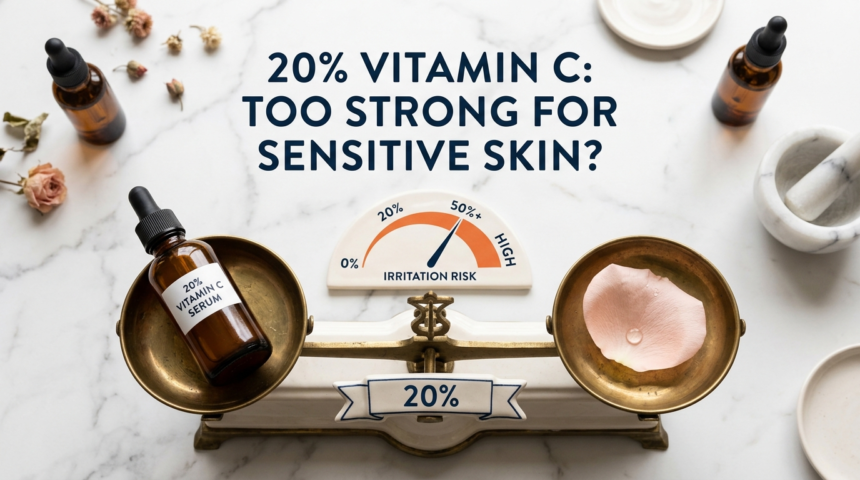
For most people with sensitive skin, yes, a 20% vitamin C serum is too strong and offers more risk than reward. While it delivers potent antioxidant benefits, clinical data indicates the efficacy of L-ascorbic acid (LAA), the most common form, plateaus at a concentration of around 20%. Beyond this point, you are not getting significantly more brightening or collagen-boosting action, but you are exposing your skin to a sharply increased risk of irritation. This creates a poor trade-off, especially for reactive or compromised skin. Instead of chasing the highest percentage, a more strategic approach using a lower concentration (like 10%), a gentler derivative, or a stabilized formula often yields better long-term results without the side effects. For a detailed breakdown of all concentrations, our comprehensive vitamin C serum percentage guide explains the sweet spots for different skin types.
- Is 20% Vitamin C Too High for Sensitive Skin?
- Vitamin C Absorption and Irritation: The Science
- What Are the Side Effects of a 20% Vitamin C Serum?
- 10% vs 20% Vitamin C for Sensitive Skin
- Safer Alternatives for Sensitive Skin
- When a High Concentration Vitamin C Serum Is Justified
- Common Questions
- When a High-Potency Vitamin C Serum Isn’t the Answer
- Conclusion
- References
Vitamin C Absorption and Irritation: The Science
Understanding why high percentages become problematic requires a look at skin biology. L-ascorbic acid must penetrate into the viable layers of the epidermis and dermis to be effective. Research into topical application has established an absorption threshold. A key study often referenced in dermatology circles demonstrates that once the skin’s transport channels for LAA are saturated, applying more does not lead to significantly deeper or greater absorption. This threshold is generally understood to be around 20%. Applying a concentration higher than this does not proportionally increase benefits.
However, the high concentration vitamin c serum risk is a separate issue. L-ascorbic acid is an acidic molecule, and at high percentages, it significantly lowers the pH of a formula to around 3.0 or lower, which is necessary for stability and skin penetration. While this low pH drives efficacy, it can also compromise the skin’s acid mantle (the protective, slightly acidic film on its surface) in sensitive individuals. This disruption can manifest as stinging, redness, dryness, flaking, or even contact dermatitis. For skin already prone to reactivity, this barrier assault can trigger or exacerbate sensitivity, undoing any potential antioxidant gains.
What Are the Side Effects of a 20% Vitamin C Serum?
The 20% vitamin c serum side effects are primarily linked to its high acidity and potency. They are more likely to occur in those with sensitive, dry, or compromised skin barriers but can affect anyone using the formula incorrectly.
- Immediate Stinging or Burning: This is the most common complaint. It occurs as the low-pH solution interacts with nerve endings in the skin, particularly if the barrier is weak or the skin is damp.
- Persistent Redness and Inflammation: Prolonged or repeated irritation can lead to visible redness and a low-grade inflammatory response, which ironically accelerates aging.
- Dryness and Flaking: The exfoliating effect of the low pH can disrupt the stratum corneum, leading to increased transepidermal water loss and peeling.
- Contact Dermatitis: In some cases, the skin can develop an allergic or irritant reaction, resulting in itchy, red, bumpy patches.
- Paradoxical Hyperpigmentation: Intense irritation can trigger post-inflammatory hyperpigmentation (PIH) in some skin tones, causing new dark spots where you were trying to fade old ones.
It is crucial to listen to your skin. Mild tingling for 30-60 seconds can be normal as the vitamin C activates, but any painful stinging that persists or visible redness is a clear signal to stop use.
10% vs 20% Vitamin C for Sensitive Skin
The choice between a 10% vs 20% vitamin c sensitive skin is one of risk management versus perceived reward. Clinical comparisons of vitamin C concentrations consistently show that 10% L-ascorbic acid is a highly effective starting point. It provides substantial antioxidant protection, boosts collagen synthesis, and brightens the skin, but with a markedly lower incidence of irritation compared to 20% formulas.
For sensitive skin, the 10% concentration represents a much safer entry point. You can always increase concentration later if your skin shows exceptional tolerance, but starting at 20% often leads to a setback that requires barrier repair, making it a counterproductive strategy. If you are new to vitamin C, our vitamin C serum for beginners guide outlines a safe introduction protocol.
Safer Alternatives for Sensitive Skin
If you want the benefits of vitamin C without the sting of high-potency LAA, several effective and gentler alternatives exist.
Vitamin C Derivatives: These are chemically modified forms of vitamin C designed for stability and lower irritation. They convert to L-ascorbic acid in the skin.
- Sodium Ascorbyl Phosphate (SAP) or Magnesium Ascorbyl Phosphate (MAP): These water-soluble derivatives are exceptionally gentle and stable. They are excellent for sensitive and acne-prone skin, though they may be slightly less potent than LAA at equivalent percentages. A 5-10% SAP serum is a fantastic starting point.
- Tetrahexyldecyl Ascorbate (THD Ascorbate): This oil-soluble derivative is highly stable, penetrates well without a low pH, and is very well-tolerated. It is often found in more premium serums.
Lower Concentration LAA (5-10%): Do not underestimate the power of a well-formulated 10% or even 5% LAA serum. Combined with other antioxidants like vitamin E and ferulic acid, these can be profoundly effective and are the cornerstone of many dermatologist-recommended routines for sensitive patients.
Buffered Formulas: Some serums incorporate calming ingredients like bisabolol, panthenol (vitamin B5), or ceramides alongside LAA to help mitigate potential irritation and support the barrier during use. Look for these in our curated list of the best vitamin C serum for sensitive skin.
When a High Concentration Vitamin C Serum Is Justified
While generally not advised for sensitive skin, a 20% vitamin C serum can be appropriate for specific, non-reactive skin types under certain conditions.
- Resilient, Oily, or Acne-Prone Skin: Skin with a robust barrier and higher sebum production often tolerates acids better. For someone with this skin type who has already successfully used a 10-15% LAA serum for several months without issue, moving to 20% could be a logical step for potentially enhanced benefits.
- Targeted, Short-Term Use: Some may use a high-potency serum as a short-course treatment (e.g., 2-3 times a week for a month) to address pronounced hyperpigmentation or dullness, provided their skin shows no signs of irritation. This is an advanced technique and requires meticulous barrier support.
- Professional Guidance: A dermatologist or aesthetician may recommend a high-concentration formula as part of a controlled, in-office or at-home treatment plan for specific concerns, where they can monitor tolerance.
Even in these cases, the principle of “start low, go slow” is paramount. Jumping straight to 20% is never recommended.
Common Questions
Can I build a tolerance to 20% vitamin C?
To some degree, yes. Your skin can acclimatize to the low pH with gradual, consistent use. However, this does not mean the initial barrier assault didn’t occur. It is far safer to build tolerance starting at 5-10%, using it every other day, and slowly increasing frequency before ever considering a jump to 20%.
How do I know if my skin is sensitive to vitamin C?
Signs include immediate, prolonged stinging (over a minute), persistent redness after application, itching, or the development of dry, flaky patches within a day or two of use. If you experience any of these, discontinue use and focus on barrier repair.
Are there any 20% vitamin C serums formulated for sensitive skin?
This is a contradiction in terms. A 20% L-ascorbic acid formula, by nature of its required low pH, is inherently irritating. While a brand may add soothing ingredients, the core formula remains highly acidic. It is more accurate to say a serum is “gentler for a 20% formula,” but it still carries a high risk for truly sensitive skin.
Is the risk of a 20% vitamin C serum worth the results?
For the vast majority of people, especially those with any degree of sensitivity, no. The marginal potential increase in efficacy over a well-formulated 10-15% serum does not justify the high likelihood of irritation, barrier damage, and potential setbacks. Consistent use of a gentler product will yield better long-term outcomes.
When a High-Potency Vitamin C Serum Isn’t the Answer
If you have a diagnosed skin condition like rosacea, active eczema, severe dermatitis, or a visibly compromised barrier (characterized by widespread redness, stinging with water, or cracked skin), a high-potency vitamin C serum is the wrong choice and will almost certainly worsen your condition. The focus must be on barrier repair using simple, nourishing ingredients like ceramides, cholesterol, and fatty acids. Furthermore, if you are experiencing an allergic reaction (intense itching, swelling, hives) to any skincare product, introducing a potent acid is contraindicated. In these scenarios, consult a dermatologist to address the underlying inflammation before considering any active treatment, antioxidant or otherwise.
Conclusion
Choosing a vitamin C serum is about balancing efficacy with your skin’s tolerance. For sensitive skin, the data is clear: the risks of a 20% concentration typically outweigh the benefits. Start with a gentle 10% L-ascorbic acid serum or a stable derivative like SAP at 5-10%. Use it consistently, monitor your skin’s response, and only consider moving up in potency if your barrier remains strong and irritation-free after several months. The most effective vitamin C serum is the one you can use daily without side effects. Check the current formulations of our recommended gentle serums to find your perfect match.
References
- Pinnell, S. R., et al. (2001). Topical L-ascorbic acid: percutaneous absorption studies. Dermatologic Surgery, 27(2), 137-142. https://doi.org/10.1046/j.1524-4725.2001.00264.x
- Telang, P. S. (2013). Vitamin C in dermatology. Indian Dermatology Online Journal, 4(2), 143–146. https://doi.org/10.4103/2229-5178.110593
- Traikovich, S. S. (1999). Use of topical ascorbic acid and its effects on photodamaged skin topography. Archives of Otolaryngology–Head & Neck Surgery, 125(10), 1091-1098. https://doi.org/10.1001/archotol.125.10.1091
- Al-Niaimi, F., & Chiang, N. Y. Z. (2017). Topical Vitamin C and the Skin: Mechanisms of Action and Clinical Applications. The Journal of Clinical and Aesthetic Dermatology, 10(7), 14–17. https://www.ncbi.nlm.nih.gov/pmc/articles/PMC5605218/