
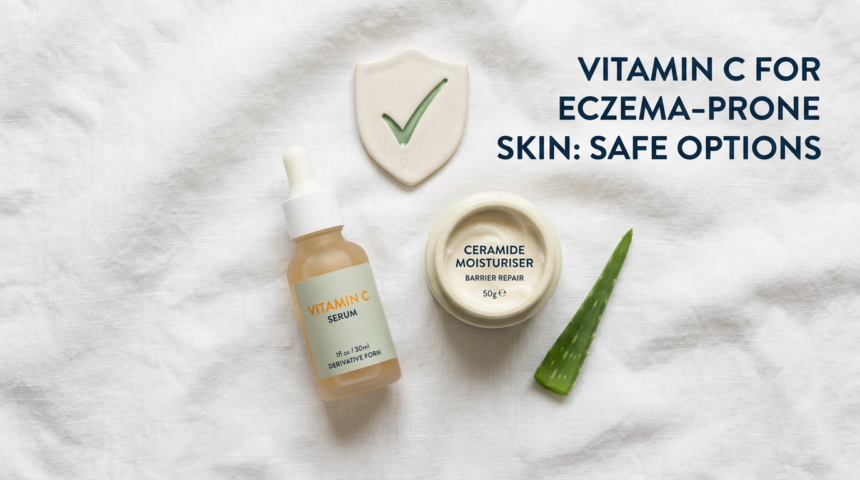
Yes, you can use vitamin C serum on eczema-prone skin, but the standard advice for resilient skin does not apply to you. If you have active atopic dermatitis or a chronically compromised barrier, using the wrong type of vitamin C can lead to stinging, redness, and a worsened skin barrier1. The answer lies not in avoiding the ingredient altogether, but in a strategic pivot: you must select an eczema-safe vitamin C derivative and adopt a protective application protocol designed for sensitive, compromised skin. This approach allows you to potentially access the antioxidant benefits of vitamin C while prioritizing your skin’s critical need for barrier repair.
- Why Standard Vitamin C Serums Are a Risk for Eczema
- The Science: Antioxidants and Atopic Dermatitis
- Choosing an Eczema-Safe Vitamin C Derivative
- The Barrier-Centric Application Protocol
- Editorial Picks: Vitamin C Serums for a Compromised Barrier
- Common Questions
- When a Vitamin C Serum Isn’t the Answer
- Conclusion
- References
Why Standard Vitamin C Serums Are a Risk for Eczema
To understand the safe path, you must first know why the most common form of vitamin C is problematic. L-ascorbic acid (LAA) is the most potent and studied form, but it requires a highly acidic formulation (pH around 3.5) to remain stable and penetrate the skin. For eczema-prone skin, this low pH presents a dual threat. First, it can temporarily disrupt the skin’s acid mantle, the protective film that helps keep pathogens out and moisture in. A compromised acid mantle is a hallmark of atopic dermatitis1. Second, LAA formulations are often potent and can cause direct irritation on skin where the stratum corneum barrier is already weakened or missing in patches. This is why many find that standard serums cause dryness or stinging, a topic we explore in depth in our guide to vitamin C serum causing dry patches.
The Science: Antioxidants and Atopic Dermatitis
Why even consider an active like vitamin C if your skin is prone to flares? Research suggests it may be beneficial. Atopic dermatitis is associated with elevated oxidative stress in the skin, meaning there is an imbalance between damaging free radicals and the skin’s own antioxidant defenses2. Topical antioxidants, including vitamin C, aim to neutralize these free radicals, potentially calming one contributor to inflammation. The goal with eczema-prone skin is not anti-aging first, but supporting skin health by addressing this underlying oxidative stress without provoking a reaction.
Oxidative stress: An imbalance between the production of cell-damaging free radicals and the body’s ability to counteract them. In eczema, this contributes to skin inflammation and barrier dysfunction.
Choosing an Eczema-Safe Vitamin C Derivative
This is the most critical step. You need to move away from L-ascorbic acid and toward a stabilized, gentler derivative. The ideal candidate is water-soluble, effective at a skin-friendly pH (closer to neutral), and has clinical data supporting its tolerability. Two derivatives stand out for eczema-prone skin.
Sodium Ascorbyl Phosphate (SAP) is another neutral-pH option, though it can be slightly more potentially irritating than MAP for some. Always avoid derivatives like Ethyl Ascorbic Acid in high concentrations if you are very sensitive, as they can still be stimulating.
The Barrier-Centric Application Protocol
How you apply the serum is as important as which one you choose. This protocol builds a protective buffer around the active ingredient.
- Barrier Prep: Start on cleansed, slightly damp skin. Apply a thin layer of a plain, fragrance-free moisturizer rich in ceramides, cholesterol, and fatty acids. This acts as a “buffer,” mitigating potential irritation and beginning the barrier repair process. Let it absorb for a few minutes.
- Short Contact with Vitamin C: Apply 2-3 drops of your chosen eczema-safe vitamin C derivative serum. Gently pat it onto your face, avoiding any actively flaring or broken skin. You do not need to leave it on for extended periods; even 10-15 minutes of contact allows for antioxidant benefit before the next step.
- Seal and Repair: After a brief wait, apply a thicker, occlusive barrier repair cream or ointment. This final layer seals in the serum and moisture, creating an ideal environment for barrier healing. For daytime, a ceramide-rich moisturizer followed by sunscreen is non-negotiable.
This method of “sandwiching” the active between barrier-supportive layers is a dermatologist-recommended strategy for introducing actives to reactive skin.
Editorial Picks: Vitamin C Serums for a Compromised Barrier
These selections prioritize gentle derivatives, minimal ingredient lists, and formulations that support barrier health. Remember, patch test any new product on a small area of clear skin for at least a week.
1. Paula’s Choice C15 Super Booster
This serum uses 15% Tetrahexyldecyl Ascorbate (THD Ascorbate) as its sole vitamin C source. It’s formulated at skin-friendly pH without alcohol or fragrance. The silky texture layers well under moisturizer.
Editorial judgment: We picked this over other THD options because of its single-active focus and clean formula, but it is a concentrated treatment. Start by mixing one drop with your moisturizer to further dilute it on first use.
Price tier: $$$
2. Geek & Gorgeous C-Glow
A fresh-made formula with a unique, gentle derivative: 15% Ethyl Ascorbic Acid (a derivative of LAA) stabilized with Ferulic Acid and Vitamin E at a moderately low pH (around 4.5-5).
Editorial judgment: This is for the eczema-prone individual whose skin is currently calm and not actively flaring. The pH is lower than pure derivatives, so it’s a “next step” option, not a first try. The fresh formulation minimizes preservatives, a plus for some.
Price tier: $$
3. Good Molecules Vitamin C Booster Powder
This is 100% pure Tetrahexyldecyl Ascorbate in powder form. You mix a tiny scoop into your favorite barrier repair moisturizer, giving you complete control over the concentration and avoiding any additional potentially irritating ingredients.
Editorial judgment: This is the ultimate in customization and safety for ingredient-scared skin. You can start with a pinch (effectively less than 1% concentration) and slowly increase. The trade-off is the extra step and less precise dosing.
Price tier: $
For a broader view of gentle formulations, our curated list of the best serums for sensitive skin includes additional antioxidant options.
Common Questions
Can vitamin C serum help repair my eczema skin barrier?
Vitamin C is not a direct barrier repair ingredient like ceramides. Its primary role here is as an antioxidant to address underlying oxidative stress2. True barrier repair for eczema requires a dedicated regimen of gentle cleansers and lipid-replenishing moisturizers used consistently. Think of vitamin C serum as a supportive player, not the star, in your barrier repair eczema strategy.
What percentage of vitamin C should I use for atopic dermatitis?
Start very low. For derivatives like MAP or THD Ascorbate, look for products under 10%. You can even begin by mixing one drop of a higher-percentage serum into your moisturizer. The goal is to provide antioxidant benefit without overwhelming your skin. Potency is less important than tolerability when your barrier is compromised.
Should I use vitamin C serum during an active eczema flare?
No. When your skin is red, itchy, weeping, or flaring, your only goal is to calm inflammation and repair the barrier. Discontinue all non-essential actives, including vitamin C. Return to your basic, prescribed topical treatments and a minimal skincare routine until your skin is fully calm for at least two weeks.
Is it safe to use vitamin C serum on dry, eczema-prone skin every day?
Not initially. Begin by using your serum 2-3 times per week, following the barrier-centric protocol. Monitor your skin closely. If you experience no increased dryness or sensitivity after a few weeks, you can consider increasing frequency. Many with eczema-prone skin find that every-other-day use provides the benefits without the risk.
Which is better for dry eczema skin: a vitamin C serum or a moisturizer with vitamin C?
For beginners, a moisturizer with a vitamin C derivative is often the wiser choice. It delivers the antioxidant in a pre-diluted, barrier-supportive base, simplifying your routine. As your skin becomes more tolerant, you can explore a dedicated serum for a more targeted effect.
What other ingredients should I pair with vitamin C for eczema?
Focus on pairing it with barrier heroes, not other actives. Niacinamide (at 5% or less) can be an excellent, well-researched partner to support the skin barrier and reduce inflammation. Always apply moisturizers rich in ceramides, hyaluronic acid, and squalane afterward. Avoid combining it with exfoliating acids (AHA/BHA) or retinoids in the same routine.
When a Vitamin C Serum Isn’t the Answer
If your eczema is severe, widespread, or currently flaring, introducing any new active serum is not advisable. Your skin’s barrier is too compromised to handle it. If you experience persistent stinging, increased redness, or itching after a careful, patch-tested trial of a gentle derivative, your skin is signaling that it’s not ready. In these cases, the correct path is to focus solely on prescription treatments (like topical calcineurin inhibitors or corticosteroids as directed by your doctor) and a minimalist, reparative skincare routine. Prioritize healing above all else. For those with highly reactive skin, exploring a dedicated vitamin C serum for sensitive skin formulated with these precise concerns in mind is a safer starting point than a standard formula.
Conclusion
Using vitamin C on eczema-prone skin is a calculated exercise in balance. Your priority must always be barrier integrity, not chasing potency. If you decide to proceed, commit to the gentler path: select a neutral-pH derivative like THD Ascorbate or MAP, start with an imperceptibly low concentration, and never skip the protective steps of buffering and sealing with barrier repair creams. For most, beginning with a single drop mixed into a trusted moisturizer, used twice weekly on calm skin, is the most reliable way to gauge tolerance. When in doubt, consult your dermatologist, as they can provide guidance tailored to your specific pattern of atopic dermatitis.
References
- British Association of Dermatologists. (2023). Atopic eczema: skin care and topical treatments. BAD Patient Information Leaflet. https://www.bad.org.uk/patient-information-leaflets/atopic-eczema-skin-care-and-topical-treatments/
- Nguyen, G. H., et al. (2016). The role of oxidants and antioxidants in atopic dermatitis. Journal of Allergy and Clinical Immunology, 137(2), AB23. https://doi.org/10.1016/j.jaci.2015.12.081