
How Do Beginners Start Using a Retinol Serum Without Irritation?
You start a retinol serum without irritation by beginning with a low-strength, gentle formula and building tolerance slowly. This means selecting a product with 0.025% or 0.05% retinol, applying it just one to two nights per week, and using the “buffer” method by applying moisturizer first. According to guidance from the American Academy of Dermatology (AAD), this gradual introduction is key to minimizing initial dryness, redness, and peeling. This approach is far more effective than jumping straight to potent percentages and hoping your skin can handle it.
- How Do Beginners Start Using a Retinol Serum Without Irritation?
- What Is Retinol? Breaking Down the Vitamin A Family
- The Beginner’s Strength Ladder: 0.025% vs 0.1% Retinol Serum
- How to Apply Retinol: The Step-by-Step Beginner Method
- Understanding Retinol Serum Side Effects and Adjustment
- Retinol Purging vs Breakout: Knowing the Difference
- What to Avoid When Using Retinol
- Choosing the Best Gentle Retinol Serum for Beginners
- Frequently Asked Questions (FAQ)
- Conclusion
Retinol is a hero ingredient for addressing fine lines, texture, and uneven tone, but its reputation for causing irritation often deters first-time users. The key is to view it as a long-term investment in your skin health that requires patience. This beginner’s guide will walk you through understanding retinol strengths, correctly identifying side effects, and building a routine that works.
What Is Retinol? Breaking Down the Vitamin A Family
Retinol is a specific type of retinoid, a family of vitamin A derivatives used in skincare. It sits in the middle of the potency spectrum among over-the-counter options, stronger than some gentler derivatives but weaker than prescription retinoids like tretinoin. It must be converted by your skin into retinoic acid, the active form that signals skin cells to renew more effectively.
Retinoid is the umbrella term for all vitamin A derivatives, including both prescription and over-the-counter options.
Understanding this hierarchy helps you choose your starting point. For most beginners, retinol offers an ideal balance of proven efficacy and manageable potency. If you have more sensitive skin or are extremely cautious, you might consider starting with a product containing retinaldehyde (often called retinal). It is one conversion step closer to retinoic acid than retinol but can still be formulated for gentleness, as we discuss in our article on retinol vs retinal.
The Beginner’s Strength Ladder: 0.025% vs 0.1% Retinol Serum
Choosing the right concentration is your first and most critical decision. The strength ladder for beginners is clearly defined: start low and go slow. A common mistake is assuming a higher percentage will deliver faster results; it often delivers faster irritation instead.
When looking at a 0.025% vs 0.1% retinol serum, the difference is significant. Clinical comparisons in sources like Dermatology Times note that while 0.1% can be more effective over time, lower concentrations like 0.025% provide noticeable benefits with a substantially lower risk of irritation. Your goal is to find the lowest strength that still gives you results. You can always increase potency later, but you cannot undo a damaged skin barrier from starting too high.
How to Apply Retinol: The Step-by-Step Beginner Method
Your application technique is just as important as the product you choose. Follow this routine to integrate retinol smoothly.
1. Start on a Dry Face: Cleanse your face with a gentle, non-drying cleanser and pat it completely dry. Wait 20-30 minutes. Applying retinol to damp skin can increase penetration and irritation.
2. Use the Buffer Method (Recommended for Beginners): Apply a pea-sized amount of your regular moisturizer to your entire face. This creates a protective layer that dilutes the retinol slightly, slowing its delivery and reducing the chance of a reaction.
3. Apply the Retinol Serum: Dispense another pea-sized amount of retinol serum. Dot it on your forehead, cheeks, nose, and chin, then gently smooth it over your face and neck, avoiding the delicate eye area and lips.
4. Follow Up with Moisturizer (if you didn’t buffer first): If you apply retinol directly, wait a few minutes for it to absorb, then apply your moisturizer. This “sandwich” method locks in hydration.
Begin with one application per week for two to three weeks. If your skin feels fine, add a second night. The goal is to work up to using it every other night, which is a sustainable, effective long-term frequency for many people. Always apply sunscreen in the morning, as retinol makes your skin more sun-sensitive. For more on combining actives, see our serum layering guide.
Understanding Retinol Serum Side Effects and Adjustment
Experiencing some initial retinol serum side effects is common as your skin adapts. This is often called “retinization.” Typical, temporary side effects include mild dryness, flakiness, slight redness, and a feeling of tightness. These are signs your skin is adjusting and usually subside within 2 to 6 weeks as your tolerance builds.
You can manage these effects by:
- Sticking to your low-frequency schedule. Do not use it more often to “push through.”
- Using a richer, barrier-supporting moisturizer.
- Applying a thin layer of petrolatum (like Vaseline) to extra-dry areas after moisturizer.
- Ensuring your cleanser is ultra-gentle and non-foaming.
If you experience severe redness, burning, stinging, or swelling, these are signs of irritation, not adjustment. Stop using the retinol, focus on soothing your skin with bland moisturizers, and consult a dermatologist before restarting with an even gentler approach.
Retinol Purging vs Breakout: Knowing the Difference
One of the most confusing aspects for beginners is distinguishing between a retinol purging vs breakout. They look similar but have different causes and timelines.
Purging is a temporary acceleration of your skin’s natural exfoliation process. Retinol increases cell turnover, bringing existing microcomedones (tiny clogs beneath the surface) to the surface faster. These appear as small whiteheads or papules, typically in areas where you normally get breakouts. Purging usually starts within the first 2-4 weeks of use and should clear within 4-6 weeks as those pre-existing clogs are cleared out.
A breakout or irritation reaction is your skin negatively reacting to the formula. This can appear as red, inflamed cysts, itchy bumps, or blemishes in areas you don’t normally break out. It can happen anytime and will not improve with continued use.
If the blemishes are small, in your usual zones, and appear within the first month before subsiding, it’s likely a purge. If they are painful, widespread, or persist beyond 6-8 weeks, it may be an adverse reaction to an ingredient in the serum itself.
What to Avoid When Using Retinol
To prevent irritation, you need to simplify your routine temporarily. Avoid using other exfoliating or potentially irritating actives at the same time as your retinol, especially when you’re starting. This includes:
- Other Exfoliating Acids: Do not use AHAs (like glycolic acid) or BHAs (salicylic acid) in the same evening routine as retinol. You can use them on alternate mornings if your skin tolerates it.
- Vitamin C (in high concentrations): While both are powerful antioxidants, using a high-strength L-ascorbic acid serum at the same time as retinol can be irritating for new users. It’s safer to use vitamin C in the morning and retinol at night, as detailed in our guide on retinol vs vitamin C.
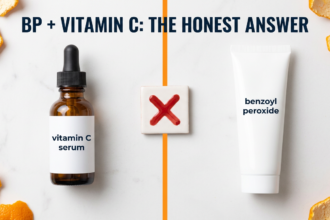
- Benzoyl Peroxide: This acne treatment can deactivate some forms of retinol and is very drying. Use them on alternate nights if needed.
- Physical Scrubs: Avoid abrasive scrubs or cleansing brushes while your skin is acclimating.
Choosing the Best Gentle Retinol Serum for Beginners
When searching for the best gentle retinol serum, look for formulations specifically designed for sensitivity and first-time use. Key features include a low concentration (0.025% to 0.05%), encapsulation technology (which slowly releases retinol to reduce irritation), and a formula packed with soothing ingredients like niacinamide, ceramides, or panthenol. These supporting ingredients help fortify the skin barrier and counteract potential dryness.
Opt for serums in airtight, opaque packaging, as retinol is unstable and degrades quickly when exposed to light and air. While we don’t list specific brands here, you can find curated, dermatologist-vetted options in our broader resource on the best retinol serums. Remember, a product marketed for “sensitive skin” or as a “starter retinol” is usually a safer bet than a high-potency formula claiming dramatic, fast results.
You might also find these guides helpfull
Say Goodbye to Blemishes with the 5 Best Acne-Fighting Serums
Everything You Need to Know About Hyaluronic Acid Serums | Top 5 Benefits
Frequently Asked Questions (FAQ)
Can I use retinol serum every day as a beginner?
No, you should not use retinol every day as a beginner. Starting with once or twice a week allows your skin to build tolerance without overwhelming it. Daily use from the outset significantly increases your risk of irritation, redness, and peeling.
How long does it take to see results from a beginner retinol serum?
You may notice improved skin texture and a subtle glow within 4 to 8 weeks. More significant results, like diminished fine lines and faded hyperpigmentation, typically become visible after 3 to 6 months of consistent use. Retinol requires patience and is a long-term skincare commitment.
Should I apply retinol before or after moisturizer?
For beginners, applying moisturizer before retinol (the “buffer” method) is recommended to reduce potential irritation. As your skin adapts over several weeks or months, you can switch to applying retinol on clean, dry skin and then following with moisturizer.
Can I use retinol if I have sensitive skin?
Yes, but you must proceed with extra caution. Start with the lowest possible concentration (0.025% or less), use the buffer method, and apply only once a week for the first month. Look for serums specifically formulated for sensitive skin with added calming ingredients.
What is retinol purging, and how long does it last?
Retinol purging is a temporary increase in breakouts as the ingredient accelerates skin cell turnover, bringing existing clogs to the surface. It typically occurs in the first 2-4 weeks and should subside within 4-6 weeks. If breakouts persist longer or are severe, it may be an irritation reaction.
Can I use retinol in the morning?
It is not recommended. Retinol can degrade and become less effective when exposed to sunlight. Furthermore, it increases sun sensitivity. Retinol is a nighttime treatment. In the morning, your non-negotiable step must be a broad-spectrum SPF 30 or higher sunscreen.
At what age should I start using retinol?
There is no specific age, but most dermatologists suggest introducing retinol in your mid-to-late 20s or early 30s as a preventive measure against early signs of aging. It can also be used earlier for acne treatment. The key factor is your skin’s concern and tolerance, not your age.
Conclusion
Starting a retinol serum successfully hinges on a philosophy of low and slow. By choosing a gentle, low-percentage formula, introducing it gradually with the buffer method, and diligently using sunscreen, you can harness retinol’s benefits while sidestepping the common pitfalls of irritation. Remember that initial side effects like mild dryness or a short purging phase are normal, but severe reactions are not. With consistent, patient use over months, retinol can become a transformative part of your skincare routine. For more detailed comparisons and specific product insights tailored to different needs, explore our related guides on the site.