
Yes, vitamin C serum is safe for teenagers to use in their skincare routine. Dermatology guidance confirms that topical vitamin C is non-toxic and safe for all ages. However, whether a teenager needs it is a separate question, and its application within a teen’s routine differs significantly from an adult’s. This guide cuts through the hype to provide an evidence-based, age-appropriate look at vitamin C serum for teenagers, covering the right formulations, how it fits into a simplified routine, and the common pitfalls to avoid.
- Understanding What Teen Skin Needs
- Is Vitamin C Serum Safe for 15 Year Olds?
- Choosing the Right Vitamin C Serum for Teen Skin
- Vitamin C Serum for Teen Acne: Setting Realistic Expectations
- How to Build a Teen Skincare Routine with Vitamin C
- Common Questions
- When a Vitamin C Serum Isn’t the Answer
- Conclusion
- References
Understanding What Teen Skin Needs
Teen skin is not simply younger adult skin. It’s often in a distinct physiological state. Hormonal shifts during adolescence increase sebum (oil) production, which can lead to clogged pores and teen acne. The skin’s cellular turnover is naturally faster, and many teens experience sensitivity or reactivity. A dermatologist consensus, including guidance from the American Academy of Dermatology, emphasizes that the foundation of any teen skincare routine should be simple: a gentle cleanser, a targeted acne treatment if needed, and a daily moisturizer with sunscreen. Adding advanced antioxidant serums like vitamin C is a secondary consideration, reserved for addressing specific concerns like early hyperpigmentation from acne marks or as a proactive shield against environmental damage for those who spend significant time outdoors.
Is Vitamin C Serum Safe for 15 Year Olds?
When parents search for the vitamin c serum safe age, the primary concern is systemic safety. The American Academy of Pediatrics and other bodies consider topical cosmetic ingredients safe for use by adolescents when used as directed on intact skin. Vitamin C (ascorbic acid) is a natural, water-soluble antioxidant present in the body; applying it topically does not pose a systemic toxicity risk. The safety question for a 15-year-old therefore shifts from biological safety to practical safety: is their skin likely to tolerate it, and is it the most effective use of their skincare focus? For most 15-year-olds, the answer leans toward keeping their routine minimalist. If they are interested in skincare and have specific concerns like post-acne marks, introducing a well-formulated, low-concentration serum can be done safely under parental guidance.
Choosing the Right Vitamin C Serum for Teen Skin
Not all vitamin C serums are created equal, and the wrong choice can lead to stinging, redness, or wasted money. For teenagers, the selection criteria are stricter.
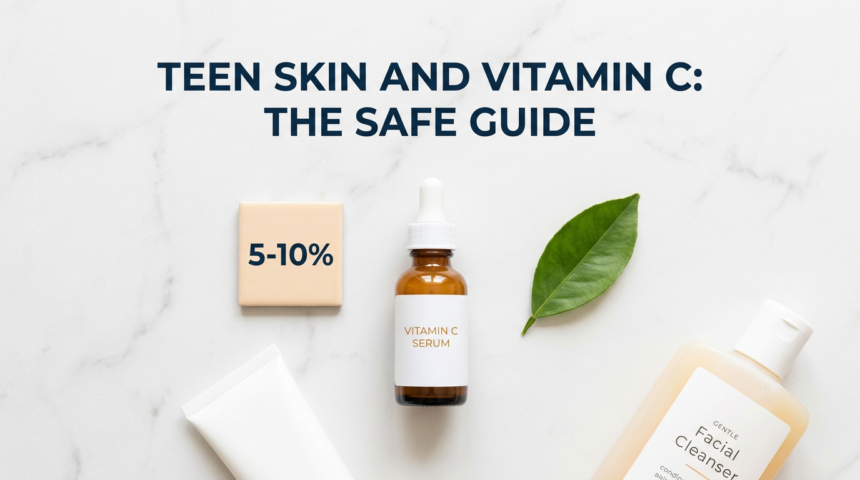
Low Concentration is Key: Adults may chase high percentages like 20% L-ascorbic acid for maximum effect, but teen skin is more reactive. Start with a concentration between 5% and 10%. This provides antioxidant benefits without the high risk of irritation associated with potent formulas. Our vitamin C percentage guide offers a deeper dive into how strength correlates with effect.
Stable, Gentle Formulas: Pure L-ascorbic acid is highly effective but also unstable and requires a low pH (around 3.5) to penetrate, which can sting. For teens, consider more stable, gentler derivatives like sodium ascorbyl phosphate, magnesium ascorbyl phosphate, or tetrahexyldecyl ascorbate. These are less irritating, though they may work more gradually.
Minimalist Ingredient Lists: Avoid serums loaded with a long list of other active ingredients (like multiple strong acids or high-dose retinols). Look for simple formulations where vitamin C is the star, supported by basic hydrators like hyaluronic acid or glycerin. Fragrance-free is always a safer bet for potentially sensitive teen skin.
Vitamin C Serum for Teen Acne: Setting Realistic Expectations
It’s crucial to manage expectations regarding vitamin c serum for teen acne. Vitamin C is an antioxidant, not a direct acne treatment. It does not kill acne bacteria like benzoyl peroxide, nor does it exfoliate inside the pore like salicylic acid. Its primary acne-related benefit is addressing the aftermath: the red or brown post-inflammatory hyperpigmentation (PIH) marks that pimples can leave behind. By inhibiting the enzyme tyrosinase involved in melanin production, vitamin C can help fade these dark spots over several weeks, especially when combined with daily sunscreen use. If active, inflamed breakouts are the main concern, vitamin C should not replace proven acne treatments.
How to Build a Teen Skincare Routine with Vitamin C
If you decide to incorporate a serum, simplicity and consistency are paramount. A basic teen skincare routine vitamin c addition should look like this:
- AM Routine: Gentle cleanser (or just rinse with water), vitamin C serum applied to slightly damp skin, oil-free moisturizer, and broad-spectrum SPF 30+ sunscreen. The sunscreen is non-negotiable; vitamin C can increase photosensitivity initially, and sun exposure darkens post-acne marks.
- PM Routine: Gentle cleanser to remove sunscreen and oil, acne treatment (if prescribed or recommended), moisturizer. Do not use vitamin C serum at night if using other active acne treatments to avoid compounding irritation.
Start Slow: Begin by applying the serum 2-3 times per week, monitoring for any redness or stinging. If tolerated, you can gradually increase to daily morning use.
Common Questions
Can vitamin C serum make teen acne worse?
It shouldn’t if you choose the right formula. Avoid heavy, oil-based serums. Opt for lightweight, water-based gels or fluids. However, if the serum causes irritation (stinging, redness), that inflammation can potentially trigger more breakouts. If you notice worsening acne, discontinue use.
What age is too young for vitamin C serum?
There’s no official age limit, but skincare for pre-teens (under 12) should be exceedingly simple: cleanser, moisturizer, sunscreen. Introducing actives like vitamin C is generally unnecessary and may irritate their delicate skin.
Should a teenager use vitamin C or retinol first?
For a teenager, retinol is rarely the first choice unless prescribed by a dermatologist for persistent acne. If starting with one active, vitamin C is the gentler introduction. They should not be used together initially. Always prioritize a prescription acne treatment plan over either.
How long until a teen sees results from vitamin C serum?
For antioxidant protection, it begins with the first application. For visible brightening or fading of dark spots, expect a minimum of 8 to 12 weeks of consistent daily use combined with sunscreen.
Are there any side effects for teens?
The potential side effects are the same as for adults: temporary tingling (common with L-ascorbic acid), irritation, or, very rarely, yellowish staining of the skin if using a highly oxidized, degraded product. For a full overview, see our guide on vitamin C serum side effects.
Can my teen use my vitamin C serum?
Likely not a good idea. Your serum is probably formulated for mature skin, possibly at a high concentration (15-20%) and low pH. It’s too strong for a beginner. They need a gentler, starter formula.
Is a drugstore vitamin C serum okay for a teenager?
Yes, absolutely. Many effective, affordable options from drugstore brands use stable derivatives at sensible concentrations. The price tag is less important than the formulation suitability.
When a Vitamin C Serum Isn’t the Answer
If your teen’s primary skin concern is active, inflamed cystic acne, widespread blackheads and whiteheads, or skin that is painfully sensitive and stings with most products, a vitamin C serum is not the solution. In these cases, the focus must be on seeing a dermatologist or general practitioner to establish an effective medical treatment plan, which may include prescription topicals or oral medications. Layering an antioxidant serum on top of uncontrolled inflammatory acne can waste resources and potentially aggravate the skin. For beginners to skincare, mastering the foundational trio of cleanse, treat (with appropriate acne medication), and protect (with sunscreen) is far more critical than adding an advanced serum. Our vitamin C serum for beginners guide reiterates this principle of building a base first.
Conclusion
Deciding to add vitamin C to a teen’s skincare routine is about prioritizing safety and suitability over anti aging marketing. For a teenager with no major acne issues who is interested in skincare and wants to tackle post-acne marks or boost daily environmental protection, a low-concentration (5-10%), stable, fragrance-free serum used in the morning under sunscreen is a safe and reasonable option. For the vast majority of teens, however, a simple routine focused on cleansing, acne treatment if needed, and relentless sun protection will deliver the most meaningful results. If you proceed, choose a gentle formula, introduce it slowly, and manage expectations: it’s a supporting player, not the star, in the story of teen skin health.
References
- American Academy of Dermatology. (n.d.). Skin care tips for teens. Retrieved from https://www.aad.org/public/diseases/acne/skin-care/tips
- Committee on Adolescence, American Academy of Pediatrics. (2013). Clinical Report: Adolescent Skin Care and Cosmetics. Pediatrics, 132(5), e1644–e1651. Retrieved from https://doi.org/10.1542/peds.2013-2698