

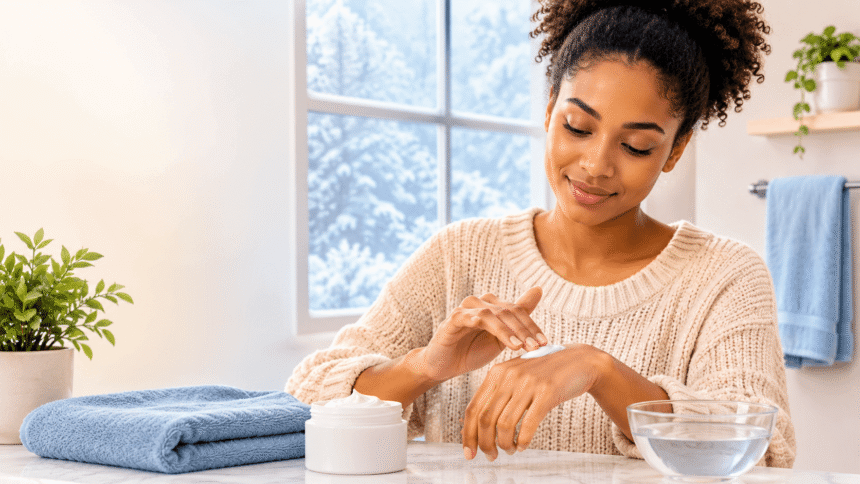
When the heat kicks on in our house, I usually notice it on our kids first. Cheeks look a little tighter. Hands feel rough after school. A lotion that was fine in September starts to sting after a shower. I’m Minesh, a dad of two kids with eczema-prone skin, and we started Eczema Honey in 2017 in Hayward, California, because winter in our family has always meant paying closer attention to the barrier.
We’re parents, not doctors, and nothing here is medical advice. These are the habits that have made winter easier on our kids’ skin. If your skin, or your child’s, worries you, a dermatologist is the right person to call.
Why winter makes sensitive skin more reactive
The skin barrier is the outer layer of skin. Its job is to hold onto water and keep everyday irritants from getting in as easily. In winter, two things change at once.
Outdoor air holds less moisture when it is cold. Indoor heating lowers the humidity even more. The American Academy of Dermatology notes that cold, dry weather makes it harder for skin to hold onto moisture, which is why so many people feel tight or flaky once the furnace starts running. Add hot showers, more handwashing, and a seat close to a heating vent, and the barrier can feel worn down.
That is also why a product that felt comfortable in July can sting in December. It may not be that the product suddenly changed. The skin it is sitting on is drier and more easily irritated. I see this every year with our kids, usually in the second or third week of consistent indoor heat.
If you want a fuller look at how cold air and indoor heat affect the skin barrier, I gathered those winter habits in our guide to winter skin barrier care.

What I pause when the air gets dry
I don’t think winter means you have to throw out a whole routine. In our house, it means we slow down the parts that ask a lot of the skin.
I pause new exfoliating acids, scrubs, and peeling masks. Dry winter skin is already losing water, and a strong exfoliant on top of that is, in my experience, the fastest way to get redness around the mouth or tightness on the cheeks. The American Academy of Dermatology has long advised people to be gentle with winter skin and to avoid harsh scrubs when the skin is already dry or irritated. We wait until the skin feels comfortable again before bringing those steps back, and we bring them back slowly.
I also pause stacking several active products in the same night. A vitamin C serum in the morning, an exfoliant at night, and a new retinoid on top of a fresh moisturizer is a lot for skin that is already dealing with dry air. One change at a time is plenty.
Hot water is the other thing we cut. A long, hot shower feels wonderful when you come in from the cold, and it is the habit I have had to unlearn the most. Lukewarm water and a shorter shower leave our kids’ skin looking calmer when we get out. We still get clean. We just don’t linger.
I am careful with new scented products in winter, too. A new body wash or a strongly scented lotion is one more variable when the barrier is already stressed. We stick with the products we already know.
What I keep, no matter how busy the week gets
The winter routine that lasts in a family house is a short one.
We keep showers lukewarm and reasonably short. We use a mild cleanser, and only where we need it. Then we pat the skin damp, not bone dry, and we put on a moisturizer while that water is still there. The American Academy of Dermatology recommends applying moisturizer to damp skin, and the National Eczema Association’s “soak and seal” idea is the same habit: a short bath or shower, then a cream or ointment right away so the water has something to hold it in.
That timing matters more than the brand name on the tube. If the cream lives in a cabinet and we walk out of the bathroom already dry, we have missed the moment. In our house the cream sits on the counter, next to the towels.
I also keep a richer cream for the driest spots — cheeks, hands, the fronts of the shins — and a lighter lotion for the rest of the body if a thick cream feels like too much in the daytime. At night, we go back to the richer layer. Cotton against the skin, rather than a rough wool sweater sitting right on a dry chest or neck, has also saved us a few itchy evenings.
A cool-mist humidifier in the bedroom, cleaned regularly, has helped the air feel less harsh at night. The American Academy of Dermatology often mentions comfortable indoor humidity as part of a winter routine. We don’t chase a perfect number. We just don’t want the bedroom to feel like paper.
Buffer a leftover active with a plain moisturizer
Some people still want to use an active product in winter, and that can be reasonable if the skin is comfortable and a doctor has already helped you plan it. What I don’t do is put a strong product on bare, tight skin.
The habit that has worked for us, and for adults in our family who still use an active now and then, is buffering. You apply a plain, familiar moisturizer first, give it a minute, and then use a small amount of the active on top, or only on the areas that tolerate it. Another version is a “sandwich”: moisturizer, a thin layer of the active, then moisturizer again.
Buffering does not make every product suddenly gentle. It just gives dry skin a cushion. If something still stings, we stop and go back to moisturizer only until the skin feels like itself again. If you want to try a new serum in January, let it be the only new product, and give it several days before you judge it.
Patch test, then add one product at a time
Our kids can react to a new soap or a new cream, so we don’t put a full-body product into the winter rotation on the first night. A patch test is simple: put a small amount on a discreet spot, such as the inner forearm, and leave it for a day or two. If that area gets red, itchy, or swollen, we don’t use it on the face or on a large area of the body.
The same idea applies to an active. A thin layer on a small area, over moisturizer, is smarter than a full-face first try on a Sunday night. The American Academy of Dermatology recommends patch testing when you are trying a new skincare product, especially if you have sensitive skin. If a routine is already working, winter is usually the wrong time to overhaul it. Keep what is comfortable. Add one thing, or take one thing away, and watch for a week.
When to check in with a dermatologist
Most winter tightness is a comfort problem, and a gentler routine is usually enough in our house. Sometimes it isn’t, and that’s when we call the doctor instead of opening another bottle.
It’s time to check in if the skin is cracking, bleeding, or painful, if redness is spreading, if you see yellow crusting or pus, if a child can’t sleep, or if a product reaction is swelling or getting worse. It is also time to call if you are not sure whether something is dryness, eczema, or another condition. We can’t tell those apart at the kitchen counter, and we shouldn’t try. A dermatologist can look at the skin and tell you what belongs in your particular routine.
Keep the routine small enough to repeat
I don’t want our kids to think of winter as the season their skin is uncomfortable. A shorter lukewarm shower, a familiar moisturizer on damp skin, a pause on harsh extras, and a little patience with new products have made the biggest difference in our house. None of those steps is complicated, which is why we can keep them up on a school night.
If you change only one thing this week, move the cream next to the shower and use it before the skin is fully dry. Pause the strongest step in your routine until the skin feels comfortable again, add new products one at a time, and talk with a dermatologist if anything worries you. A quieter winter routine is not a step backward. In our family, it is how we get through the dry months with skin that feels more like itself.